



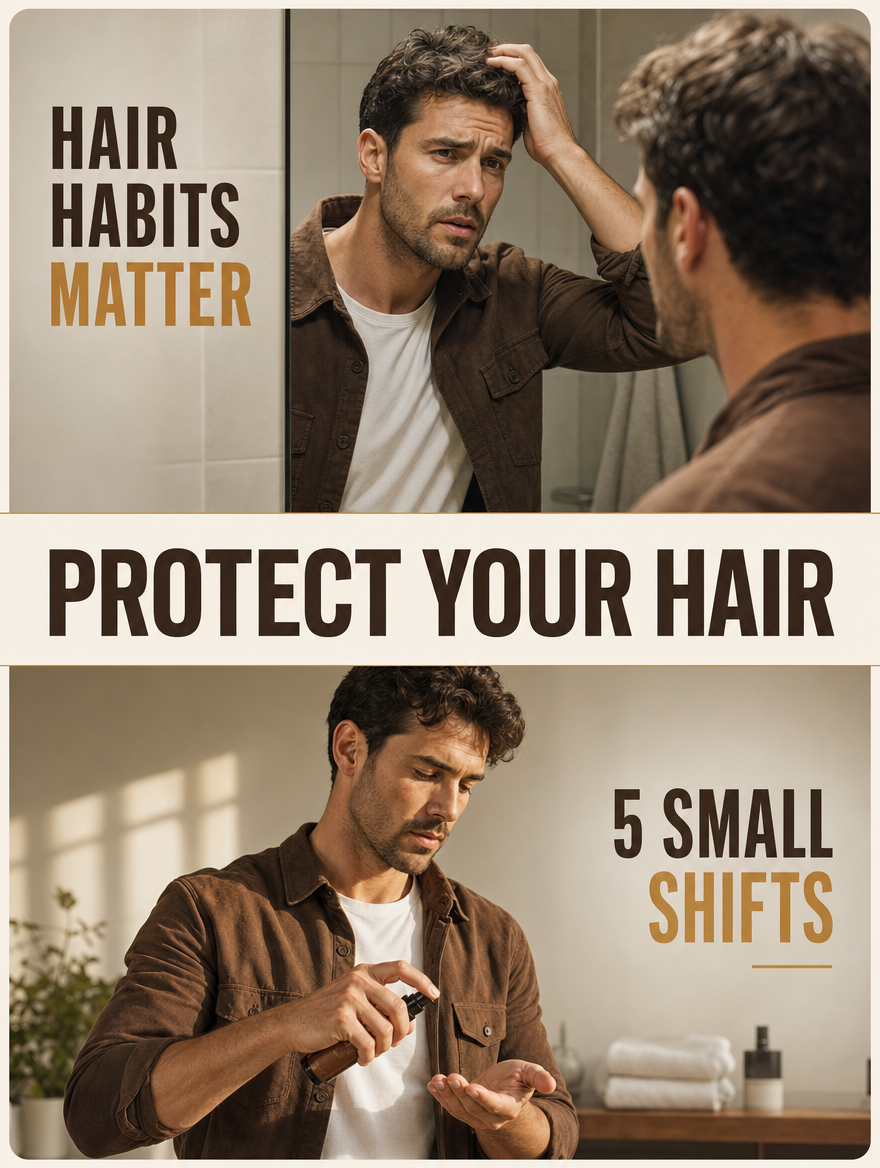
5 Habits That Help Protect Your Hair
Hair loss does not have a single cause. Genetics, age, stress, nutrition, medical conditions, medications, and everyday grooming habits can all play a role.
While no routine can prevent every type of hair loss, changing a few damaging habits may help reduce unnecessary breakage and protect the hair you already have.
The goal is not a dramatic overnight transformation. It is a gentler routine you can realistically maintain.

1. Turn Down the Heat
Heat can make styling faster, but excessive heat may weaken the hair shaft and increase dryness and breakage.
Holding a hair dryer close to your scalp at its highest temperature is not necessarily more effective. A lower heat setting, greater distance, and shorter drying time can provide a gentler alternative.
When possible, allow your hair to dry partially before using a dryer. Avoid repeatedly heating the same section, and do not keep the dryer pressed close to your scalp.
A small temperature change can make your daily routine noticeably gentler.

2. Reduce Unnecessary Tension
Hairstyles that repeatedly pull on the hair can create continuous tension around the hairline and scalp.
Very tight ponytails, braids, buns, extensions, or other restrictive styles may contribute to a condition known as traction alopecia. When that tension continues for a long time, the damage may become more difficult to reverse.
Your hairstyle should not feel painful, create a headache, or leave your scalp feeling sore.
Choose looser styles, change where you part or tie your hair, and give your scalp regular breaks from anything that pulls tightly.
Comfort is a useful signal. If a hairstyle hurts, loosen it.

3. Be Gentler With Wet Hair
Hair can be more vulnerable to stretching and breakage when it is wet. Aggressively rubbing it with a heavy towel creates unnecessary friction and tangling.
Instead, gently press or blot your hair with a soft microfiber towel. Avoid twisting, pulling, or rubbing it back and forth.
If your hair tangles easily, use a wide-tooth comb and work gradually from the ends rather than pulling from the roots. A conditioner or detangling product may also help reduce friction.
The objective is simple: remove moisture without treating your hair roughly.

4. Avoid Extreme Crash Diets
Hair is not the body’s highest survival priority. When calorie or nutrient intake becomes severely restricted, the body may redirect its resources toward more essential functions.
Insufficient protein, iron, or overall calorie intake can be associated with increased shedding in some people. This does not mean that one specific food or supplement can prevent hair loss. It means your hair benefits from the same balanced nutrition that supports the rest of your body.
Build meals around realistic portions of protein, vegetables, healthy fats, and whole-food carbohydrates. Avoid extreme plans that are difficult to maintain or eliminate entire food groups without a medical reason.
If you suspect a nutrient deficiency, speak with a healthcare professional before taking high-dose supplements. Testing the cause is more useful than guessing.

5. Notice Changes Early
Finding additional hair in the shower does not automatically mean you are developing permanent hair loss. Some shedding is normal, and temporary shedding can occur following stress, illness, weight loss, surgery, or major life changes.
However, sudden shedding, circular bald patches, scalp pain, persistent itching, or a rapidly changing hairline should not simply be ignored.
Different types of hair loss require different approaches. A dermatologist can examine your scalp, review your medical history, and help identify the likely cause before you spend money on random treatments.
No treatment works for every cause, so early evaluation is often more valuable than trial and error.

Build a Routine, Not a Miracle
Protecting your hair is rarely about finding one perfect product. It is about reducing repeated damage and building habits that are gentle enough to maintain.
Start with the fundamentals:
-
Use less heat.
-
Avoid constant tension.
-
Handle wet hair gently.
-
Eat consistently rather than following crash diets.
-
Seek professional advice when changes become noticeable.
Small habits may not feel dramatic, but they are easier to repeat—and repetition is what makes a routine last.
Explore daily hair wellness and grooming routines from The Helixmane Journal.


Leave a comment
This site is protected by hCaptcha and the hCaptcha Privacy Policy and Terms of Service apply.